
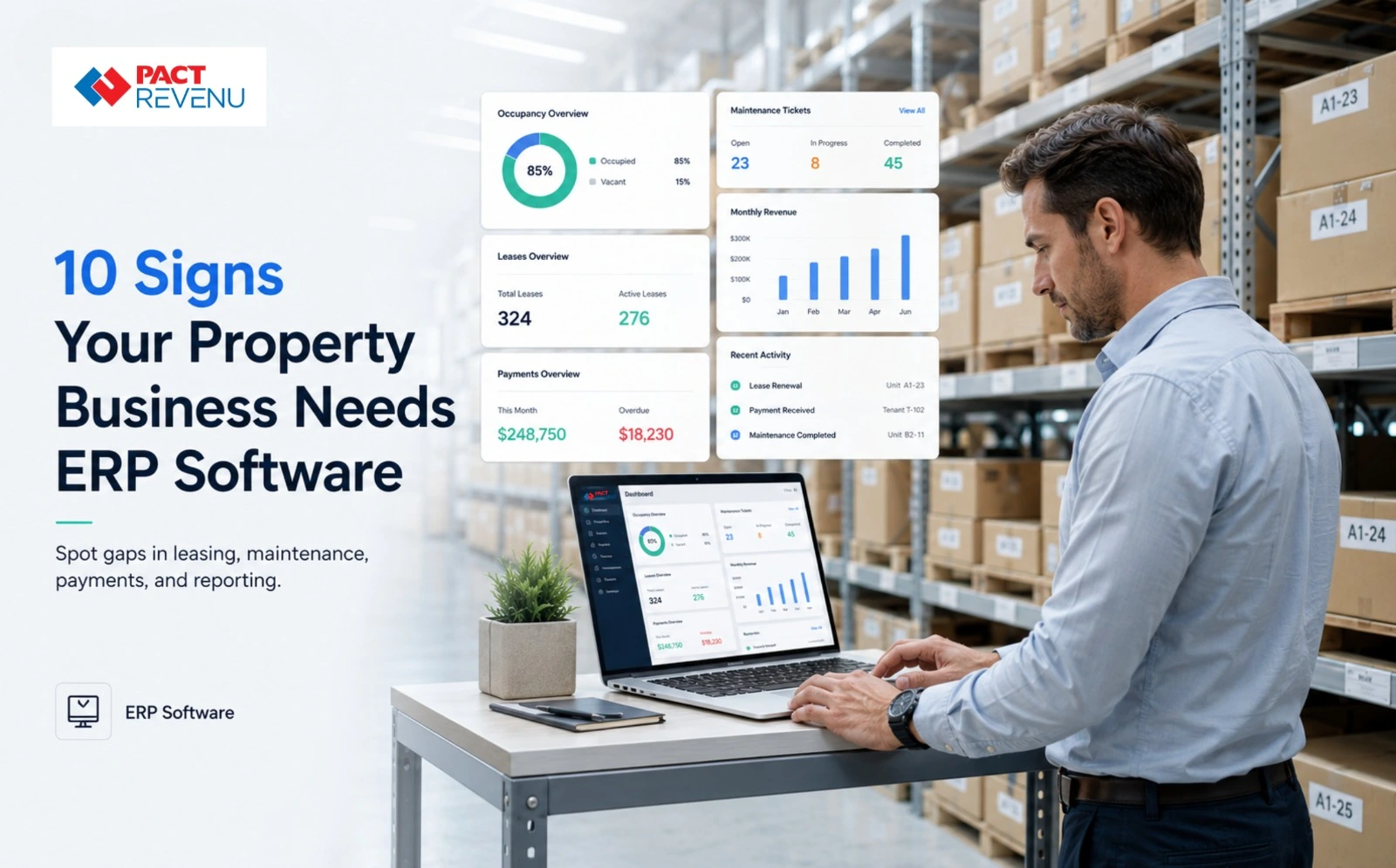
10 Signs Your Property Business Needs ERP Software in Saudi Arabia
Saudi Arabia’s real estate sector has changed shape fast. Vision 2030 has pulled in new investment, new mega-projects, and a wave of property businesses expanding well beyond their original city. A developer that once managed a handful of buildings in Riyadh now finds itself with commercial units in Jeddah and a facility management contract in Dammam, all within a few years. That kind of growth is good news, but it also exposes something quietly: the spreadsheets and disconnected tools that worked fine for a smaller operation start breaking down under the weight of more properties, more tenants, and more regulatory obligations.
Add ZATCA e-invoicing requirements and VAT compliance into the mix, and manual processes stop being just inefficient — they become a genuine risk. This is usually the point where property businesses in Saudi Arabia start evaluating ERP software seriously. Not as a trend to follow, but as infrastructure that has to exist for the business to keep functioning at scale. PACT REVENU was built with exactly this shift in mind, bringing leasing, finance, compliance, and reporting onto a single platform. Below are ten signs that tend to show up before a property business finally makes that move.
What is Property Management Software and How Does it Integrate with ERP Solutions?
Property management software definition, put simply, is a system built to handle the operational side of running properties: tenants, leases, maintenance requests, and rent tracking. Saudi property businesses lean on this kind of software because manual tracking across multiple developments, especially once a company expands beyond a single city, becomes unworkable fairly quickly.
On its own, though, property management software only solves part of the problem. ERP software integration is what connects those day-to-day operations to the rest of the business. When rent is collected, that transaction should reflect in the company’s accounts automatically. When ZATCA-compliant invoices are generated, they should draw from the same tenant and lease data the property team already maintains, not a separately maintained spreadsheet. That’s where property management system benefits really show up: fewer duplicated records, fewer reconciliation errors, and financial numbers that are accurate the first time.
PACT REVENU supports this by keeping property operations, finance, and compliance functions within one system rather than a patchwork of tools that only sometimes sync correctly. For a property business managing developments in both Riyadh and Jeddah, that means one platform handles leasing in each city while consolidating reporting at the company level.
Key Features and Benefits of Property Management Software
Most growing property businesses in Saudi Arabia need a similar foundation of capabilities:
Tenant management — a centralized record of every tenant, lease terms, and communication history, rather than fragmented files across different staff members.
Lease management — automated alerts ahead of renewals and expirations, particularly useful for portfolios with staggered lease cycles across multiple cities.
Maintenance scheduling — requests logged, assigned, and tracked to closure, instead of relying on phone calls that get forgotten.
Automated rent collection — reminders and reconciliation that don’t depend on someone manually cross-checking bank transfers.
Vendor management — a clear record of contractors and service providers, along with payment schedules and service history.
Asset management — tracking building assets like HVAC systems, elevators, and generators, including maintenance history and depreciation.
Reporting and analytics — real-time visibility into occupancy and collections across every property, without waiting for someone to compile a manual summary.
Financial tracking — expenses, income, and outstanding balances visible at both the property and portfolio level.
For a facility management firm servicing commercial buildings in Dammam, or a residential developer managing multiple communities around Riyadh, these aren’t optional extras. They’re what separates a business that scales smoothly from one that starts losing money to inefficiency.
Understanding ERP Software
ERP, short for Enterprise Resource Planning, connects the different operational areas of a business — finance, CRM, procurement, inventory, HR — so they share one set of data instead of running in isolation. For property businesses in Saudi Arabia, this matters for a reason specific to the current regulatory environment: ZATCA e-invoicing.
Since electronic invoicing is now a compliance requirement, a business still generating invoices manually or through disconnected accounting software is exposed to errors and delays that can affect audits. Business process automation through ERP means invoices are generated in the correct format automatically, VAT is applied consistently across leases and service agreements, and financial reporting reflects real numbers without a finance team manually reworking figures each month. Real-time dashboards give leadership visibility into how each property, and each city, is performing without waiting on a scheduled report. And because a residential developer and a commercial facility management company don’t operate identically, ERP customization allows the same core platform to adapt to different business models within the same industry.
PACT REVENU connects finance, CRM, procurement, inventory, and HR within one integrated platform, so property businesses aren’t maintaining separate systems just to stay compliant with ZATCA and VAT requirements.
10 Signs Your Property Business Needs ERP Software in Saudi Arabia
1. You’re still relying on spreadsheets. If lease terms, maintenance logs, and financial records live across multiple Excel files maintained by different people, small inconsistencies build up until nobody fully trusts the numbers.
2. Rent collection is becoming difficult. Manually tracking who has paid, who’s overdue, and who’s on an installment plan gets harder as the tenant base grows. ERP software automates reminders and reconciles payments as they come in.
3. Tenant complaints are increasing. Without a central system logging every interaction, tenants end up repeating requests, and response times slow down. A unified platform tracks each complaint from submission to resolution.
4. Financial reports take too long to prepare. If putting together a monthly report means pulling numbers from four different sources, decision-making lags behind what the business actually needs. ERP systems generate reports directly from live data.
5. Maintenance requests are difficult to manage. Verbal complaints and scattered WhatsApp messages mean issues get duplicated or missed entirely. ERP-based maintenance tracking assigns clear ownership and keeps a visible status trail.
6. Different departments use disconnected software. When finance, leasing, and maintenance each run on separate tools, someone ends up re-entering the same data multiple times. This is precisely the fragmentation that ERP software integration is designed to eliminate.
7. You lack real-time business insights. If leadership only reviews performance once a month, problems surface too late to act on efficiently. Real-time dashboards catch issues while there’s still time to respond.
8. Managing multiple properties across different cities is becoming challenging. Riyadh, Jeddah, and Dammam each come with their own tenant mix, service providers, and reporting needs, and spreadsheets weren’t built to handle that kind of geographic spread.
9. VAT and ZATCA compliance consume too much manual effort. If someone is manually preparing e-invoices and VAT calculations across dozens of leases, the margin for error grows with every additional property added to the portfolio.
10. Your business growth is being limited by outdated systems. Sometimes the constraint isn’t market demand under Vision 2030’s real estate push — it’s that internal systems can’t onboard new properties fast enough to keep up with it.
On their own, these signs might look like minor operational friction. Together, they usually point to a structural gap that spreadsheets and disconnected software can’t close — which is exactly what PACT REVENU was built to address for property businesses operating across Saudi Arabia.
Choosing the Right ERP for Property Businesses
Before selecting a platform, it’s worth evaluating a few factors specific to how property businesses operate in the Kingdom:
Cloud ERP — accessible from any office or site, not tied to a single physical location.
Scalability — does it hold up as the business expands from one city to several?
Mobile accessibility — useful for facility teams and site staff, not just back-office employees.
Integration capabilities — does it connect with accounting or CRM systems already in place?
User-friendly interface — a system the team will actually adopt rather than avoid.
Data security — tenant and financial data need proper protection under increasingly strict data governance expectations.
Vendor support — responsive local support when issues come up.
Customization — flexibility to serve a residential community differently than a commercial portfolio.
Reporting — depth and flexibility to produce the specific reports the business needs.
Saudi compliance requirements — ZATCA e-invoicing support and consistent VAT handling built into the core system.
Future business growth — a platform that supports the next stage of expansion, not just current operations.
Weighing these factors carefully, instead of choosing based on upfront cost alone, tends to prevent an expensive platform switch a couple of years down the line.
Conclusion
Saudi Arabia’s real estate sector is growing quickly under Vision 2030, and that growth is exactly what exposes the limits of spreadsheets and disconnected systems. ZATCA compliance, VAT reporting, multi-city portfolios, and rising tenant expectations all demand a level of coordination that manual processes simply can’t sustain. Digital transformation isn’t just a buzzword here — it’s becoming a practical requirement for property businesses that want to keep scaling without operational chaos.
If several of the signs above sound familiar, it’s worth exploring how PACT REVENU brings finance, leasing, maintenance, and compliance onto one integrated platform, so property businesses across Saudi Arabia can spend less time firefighting operations and more time growing.
FAQs
1. What is ERP software for property businesses in Saudi Arabia?
It’s a system that connects property operations like leasing, rent collection, and maintenance with finance, ZATCA-compliant invoicing, and company-wide reporting on a single platform.
2. Does ERP software support ZATCA e-invoicing requirements?
Yes, ERP systems built for the Saudi market generate compliant e-invoices automatically, reducing the manual work involved in meeting ZATCA requirements.
3. Is ERP software practical for smaller real estate companies in Saudi Arabia?
Yes, particularly cloud-based ERP solutions that scale gradually, allowing smaller companies to adopt only the capabilities they currently need.
4. Can ERP software manage properties across different Saudi cities from one system?
Yes, a centralized ERP like PACT REVENU allows businesses to manage properties in Riyadh, Jeddah, Dammam, and elsewhere from a single dashboard, with consolidated reporting.
5. How does ERP software help with VAT compliance for real estate businesses?
It applies VAT consistently across leases and service charges, reducing manual calculation errors and simplifying reporting during audits.
6. How long does ERP implementation usually take for a property business in Saudi Arabia?
Timelines depend on portfolio size and data complexity, but most businesses can expect a phased rollout over several weeks to a few months.

 EN
EN  AR
AR