
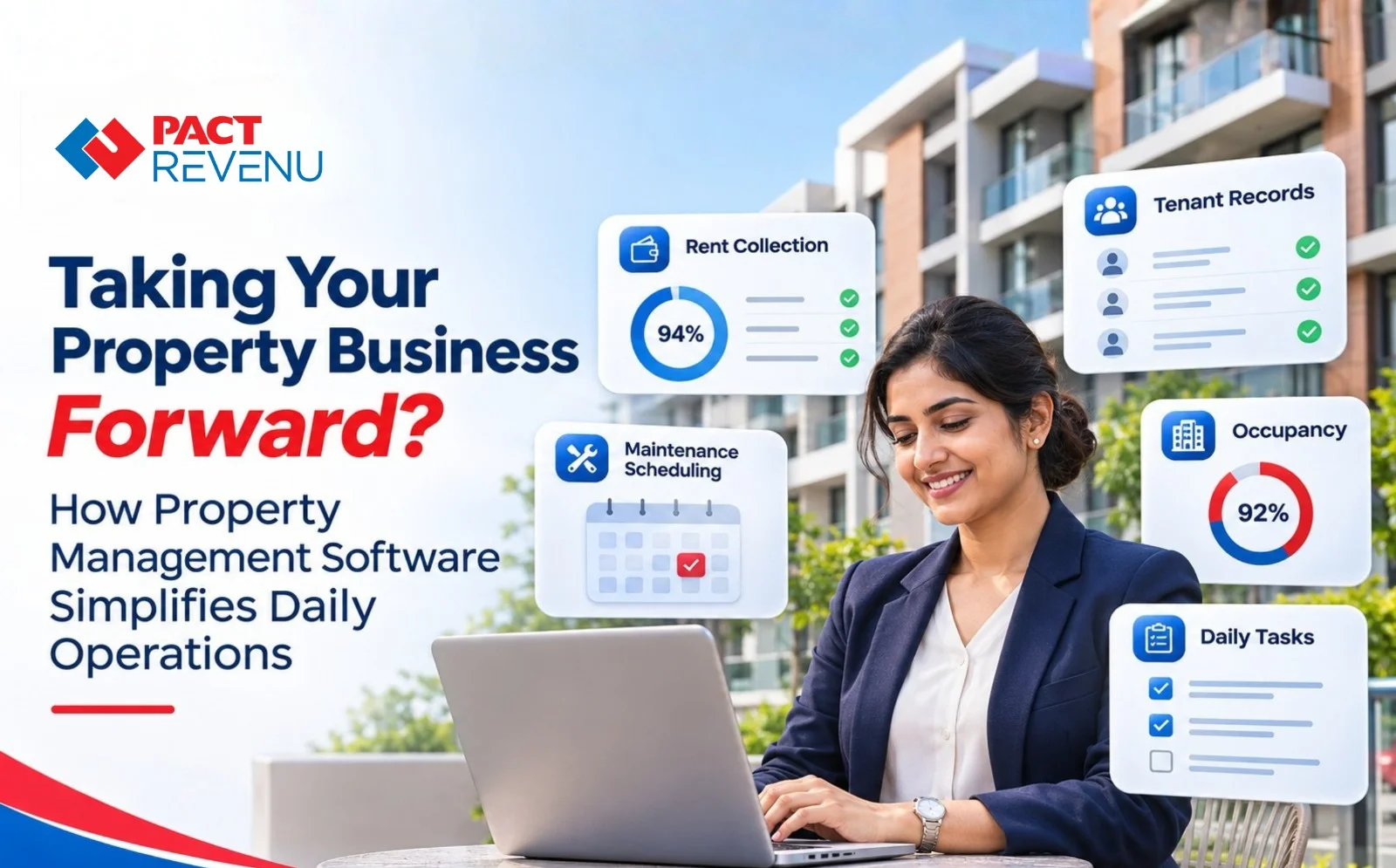
Taking Your Property Business Forward? How Property Management Software Simplifies Daily Operations
Rent is due on the first, a lease expires next month, a tenant in Jeddah reports a faulty air conditioner and nobody can confirm which payments have arrived. For many property owners and managers in Saudi Arabia, that is an ordinary working day. When tenants, contracts, repairs and payments live in spreadsheets, chat threads and paper files, something eventually slips. Property management software brings that information into one system, so your team can see what needs attention today.
PACT REVENU, an ERP platform with dedicated property modules, is built for this kind of work. This guide covers where daily operations break down, what a centralized system changes and how to choose one.
Everyday Challenges in Managing Property Businesses
Running rental properties looks simple from the outside. In practice, small gaps in daily property management add up quickly. The most common pressure points are:
- Multiple properties: buildings, units and owners tracked in separate files.
- Rent tracking: no clear view of who has paid and which balances are outstanding.
- Tenant enquiries and complaints: messages arrive by phone, WhatsApp and email and some get lost.
- Maintenance requests: no reliable record of who is fixing what, or what it cost.
- Leases and documents: renewal dates missed and signed contracts hard to find.
- Daily coordination: team members working from different versions of the same information.
- Accurate records: figures that do not match when an owner asks for a report.
These gaps cost more than time. Staff repeat the same checks every month, tenants wait for answers and owners lose trust in the numbers. A missed renewal can leave a unit empty for weeks. The root problem is scattered information and spreadsheets were never designed to be real property management software.
How Does Property Management Software Simplify Daily Operations?
A centralized platform replaces scattered files with one shared record. In practice:
- Centralized property information. Every building, unit and owner sits in one record, so answering an owner’s call does not mean opening five files.
- Tenant and lease management. Contract dates, rent amounts and tenant details stay linked, so renewal talks can start weeks early. Renewal alerts and lease tracking make that routine.
- Rental payment tracking. Invoices, receipts and outstanding balances appear together, so monthly follow-up becomes a short list.
- Maintenance request management. A request is logged, assigned, tracked and closed, with the cost recorded against the property.
- Automated reminders and notifications. Alerts for due rent and lease dates replace sticky notes and personal calendars.
- Property reporting. Occupancy, income and expense reports come from live data, not monthly rebuilds.
- Better visibility. Managers see what is open, overdue or expiring today in a single view.
- Organized records. Contracts and payment history stay attached to the right tenant and unit, which helps when staff change.
Important Features to Look For Before You Choose
Real property management software does more than store tenant names. Use these seven areas as a practical test during any demo and ask to see each one working with your own scenario.
- Portfolio management. Every property and unit should show its status, or vacancies stay hidden until month-end.
- Tenant management. Contact details, unit history and payments in one profile mean faster answers.
- Lease and contract management. Stored contracts and renewal alerts protect rental income, because an unnoticed expiry is lost revenue.
- Rent collection and financial tracking. Look for invoicing, payment status and a link to your accounts, so finance avoids re-entry.
- Maintenance management. Assignment, status and cost history show which buildings cost the most to maintain.
- Reporting and analytics. Reports should answer the questions owners actually ask: occupancy, arrears, income and expenses.
- User access and data management. A leasing officer and an accountant need different permissions.
A feature matters only if it removes a step your team repeats. When you review any property management software, ask which daily task each one replaces.
Supporting Property Management Companies and Growing Businesses
- Real estate companies can compare leased assets and projects in one view. See how PACT REVENU supports real estate businesses.
- Property managers often handle many owners at once. Separate records for each owner reduce mix-ups.
- Rental property owners get collection and expense tracking without hiring extra admin staff.
- Businesses managing multiple properties in Riyadh, Jeddah and Dammam can coordinate teams and repairs from one dashboard.
- Growing portfolios need room to add units and users without rebuilding spreadsheets.
Property Management Software for Small Landlords
Picture a landlord in Dammam who rents out ten apartments. A heavy system would be wasted. The useful basics are tenant records, rent tracking, lease reminders and simple expense reports. Reminders alone can replace a monthly round of phone calls.
Across all of these cases, better property management starts with visibility. When information is organized, coordination improves, manual work shrinks and the business can add properties without adding confusion.
Choosing the Right Solution for a Saudi Property Business
Start with your own operations, not a feature list: write down where your team loses time today, then judge each option against it.
- Business size and portfolio: properties, units and users now and in two years.
- Required features: separate must-haves from nice-to-haves.
- Ease of use: if staff avoid it, the data goes stale.
- Reporting: can it produce the reports owners request?
- Scalability: can you add properties and users without a rebuild?
- Data security: ask how access, backups and hosting are handled.
- Integration: does it connect with your accounting and other systems?
- Local requirements: check how it fits your invoicing, tax and rental procedures in Saudi Arabia.
Rules and tax requirements change, so confirm current obligations with the relevant authorities or a qualified adviser, not a vendor’s summary alone.
The best property management software is the one that fits your portfolio, your team and your budget. PACT’s practical evaluation checklist covers these questions in more depth.
Why Choose PACT REVENU for Property Operations?
PACT REVENU is an ERP platform from PACT, whose property modules follow the daily tasks described above. Its property management software covers lease tracking, tenant billing, maintenance monitoring and property analytics from a single system.
Lease records come with renewal alerts, automated invoicing and payment reminders and one dashboard for multiple properties, tenants and units.
Service requests and repair scheduling sit in the same system. The maintenance and service request features let teams track service providers and tie repair costs back to accounting.
Because everything runs on one ERP platform, finance and reporting use the same data. PACT lists on premise, private cloud, public cloud and SaaS deployment options and its website describes ZATCA e invoicing support. Confirm how they apply to your setup in a demo.
Still working from spreadsheets and chat threads? Request a personalized demo from the PACT team and bring a realistic scenario.
Final Thoughts: Clearer Operations, Less Manual Work
Property work is full of small, repeating tasks: chasing rent, watching lease dates, logging repairs and answering owners. Property management software keeps those tasks visible and organized, so your team spends less time searching and more time acting. For Saudi property businesses with portfolios spanning several cities, that visibility matters more as the business grows.
PACT REVENU gives owners, landlords and operators one place to manage leases, rent, maintenance and reports. Visit the official PACT REVENU website to explore the platform and book a demo.
Frequently Asked Questions
What is property management software and how does it work?
It is a digital platform that stores property, tenant, lease, payment and maintenance records in one system. Staff enter data once, then use it to issue invoices, track rent, monitor lease dates, assign repairs and produce reports. Everyone works from the same current information.
How can property management software simplify rental operations?
It simplifies rental operations by automating repetitive steps such as invoicing, reminders and renewal tracking. Rent status, lease dates and repair requests appear together, so staff stop reconciling separate files. Managers spot overdue payments and expiring contracts earlier, which keeps follow up consistent.
What features make the best property management software for Saudi landlords?
The most useful features are tenant and lease management, rent tracking, maintenance workflows, reporting and controlled user access. Add accounting integration and room to grow. Prioritize whatever solves your biggest daily problem, whether late rent, missed renewals or slow repairs.
Is property management software for small landlords worth it in Saudi Arabia?
Yes, if it replaces manual tracking you already spend time on. Even a landlord with a few units benefits from rent records, lease reminders and a maintenance history. Choose a simple tool your team will use daily and skip modules you do not need.
How can property management companies manage multiple properties efficiently?
They can manage multiple properties efficiently by keeping every unit, tenant, lease and work order in one shared system. A single dashboard shows occupancy, arrears and open repairs across locations. Standard workflows and role based access let teams add buildings without adding paperwork or confusion.

 EN
 AR