
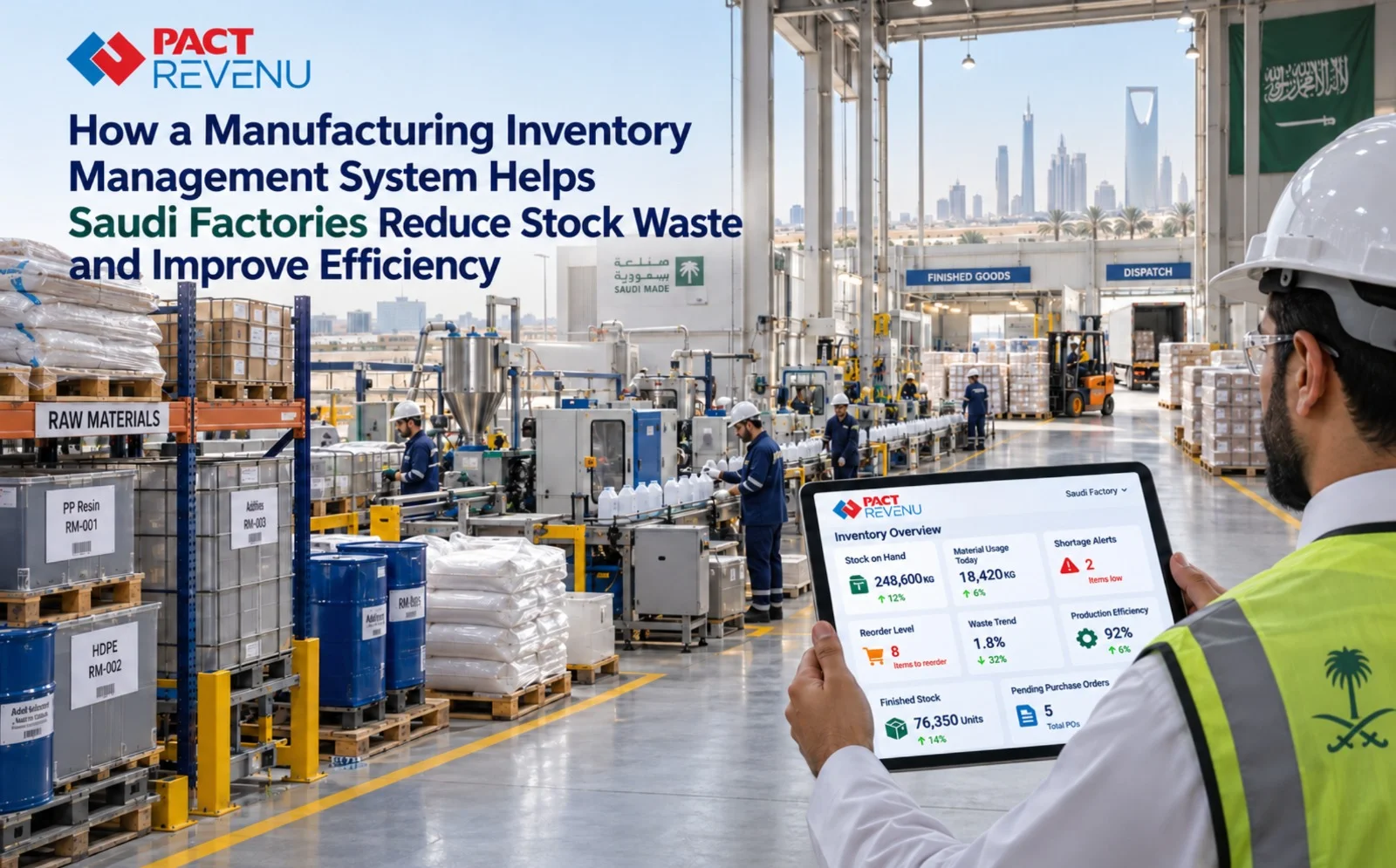
How a Manufacturing Inventory Management System Helps Saudi Factories Reduce Stock Waste and Improve Efficiency
Saudi Arabia’s manufacturing sector is growing as the Kingdom continues to invest in industrial development, local production, and supply chain improvements under Saudi Vision 2030. For manufacturers, this growth creates opportunities, but it also brings challenges such as rising material costs, excess inventory, production delays, and increasing pressure to deliver products on time.
Efficient inventory management is essential for businesses of all sizes. Raw materials must be available when manufacturing begins, work-in-process items must be properly monitored, and finished goods must be ready for distribution without taking up unused warehouse space. When inventory records are inaccurate or disconnected from production activities, businesses may experience material shortages, stock waste, and avoidable operating expenses.
A Manufacturing Inventory Management System helps Saudi factories address these challenges by bringing inventory tracking, material planning, warehouse operations, and stock reporting into a more organised process. With the right system, manufacturers can improve stock visibility, make informed purchasing decisions, and use available resources more effectively.
For businesses looking to modernise their operations, PACT REVENU provides business management software solutions designed to support more connected and efficient workflows.
What Is a Manufacturing Inventory Management System?
A Manufacturing Inventory Management System is a software solution that helps factories monitor and manage the movement of materials throughout the production cycle. It provides visibility into available stock, incoming supplies, materials issued to production, work-in-progress items, and finished goods.
Instead of relying entirely on spreadsheets, handwritten records, or separate departmental files, manufacturers can maintain centralised inventory information and access more reliable stock data.
For example, a factory in Riyadh producing industrial equipment may need to manage hundreds of components from different suppliers. If purchasing, warehouse, and production teams work with separate records, the factory may order materials it already has or discover shortages only after production starts.
A connected inventory system helps teams check stock availability, track material usage, and plan replenishment before these problems affect production.
Depending on the software and its configuration, manufacturers may also benefit from barcode scanning, batch and serial number tracking, warehouse management, purchase order integration, and automated inventory reports.
Why Saudi Factories Need Better Inventory Control
Manufacturing businesses in Saudi Arabia operate across industries such as food processing, packaging, chemicals, construction materials, metal fabrication, and industrial equipment. Each sector has different inventory requirements, but many face similar operational challenges.
1. Excess Stock Increases Operating Costs
Purchasing more materials than necessary can tie up working capital. Excess stock also occupies warehouse space and may require additional handling, storage, and insurance.
Some materials have limited shelf lives, while others can become outdated because of product changes or shifting customer demand. If these items remain unused for too long, businesses may experience financial losses.
A manufacturing inventory system helps businesses monitor stock levels and identify slow-moving materials. Managers can use this information to adjust purchasing quantities and avoid unnecessary stock accumulation.
2. Material Shortages Disrupt Production
Production schedules depend on the timely availability of raw materials and components. When inventory records are inaccurate, employees may believe materials are available even when the actual quantities are insufficient.
This can delay manufacturing orders, interrupt production lines, and affect customer delivery commitments.
With real-time or frequently updated inventory information, production planners can detect shortages earlier and work with purchasing teams before materials are required.
3. Manual Stock Tracking Creates Errors
Manual data entry increases the risk of duplicate records, incorrect quantities, missed transactions, and delayed reporting. These errors can become more difficult to manage as a factory adds products, suppliers, warehouses, or production lines.
Inventory management software for manufacturing helps to organise stock transactions and keep information more uniform across divisions.
4. Poor Stock Visibility Makes Planning Difficult
Without a clear overview of inventory, managers may struggle to determine which materials are available, which items are reserved for production, and which supplies need replenishment.
A centralised inventory dashboard gives authorised teams better access to stock information, helping them make decisions based on recorded inventory levels rather than assumptions.
How a Manufacturing Inventory Management System Reduces Stock Waste
Reducing waste involves more than purchasing fewer materials. Factories has to comprehend inventories movement, where losses occur, and when stuff is likely to become outdated.
1. Maintain Accurate Stock Levels
A manufacturing inventory management system helps track stock received, transferred, issued, consumed, and dispatched. When transactions are recorded consistently, businesses can compare system quantities with physical stock and investigate discrepancies.
Accurate inventory information reduces the risk of overordering materials simply because employees cannot confirm what is already available.
Regular cycle counts and physical stock verification remain important because software accuracy depends on correct processes and timely transaction updates.
2. Identify Slow-Moving and Excess Inventory
Not every material moves through a factory at the same speed. Some components are used daily, while others may remain in storage for weeks or months.
Inventory reports can help managers identify items with low consumption, excessive quantities, or long storage periods. They can then review purchasing plans, use existing materials where appropriate, or adjust future orders.
For Saudi manufacturers managing costly imported components, this visibility can be particularly useful when procurement involves long lead times or minimum order quantities.
3. Improve Batch and Expiry Tracking
Manufacturers handling food ingredients, chemicals, pharmaceuticals, or other time-sensitive materials need reliable batch and expiry information.
Where supported, batch tracking and first-expiry-first-out (FEFO) processes help warehouse teams prioritise materials approaching their expiry dates. First-in-first-out (FIFO) can also support stock rotation for suitable products.
These practices help reduce avoidable spoilage, improve traceability, and make it easier to identify affected batches when quality issues arise.
4. Reduce Material Loss During Production
Materials can be wasted because of inaccurate production quantities, damaged components, incorrect storage, or unexpected production changes.
Manufacturing inventory software can help businesses compare planned material requirements with actual consumption. This makes it easier to identify unusual usage patterns and investigate the causes of recurring losses.
For example, if a production order repeatedly consumes more packaging material than expected, managers can examine handling procedures, machine settings, or the accuracy of production estimates.
5. Support Better Warehouse Organisation
A well-organised warehouse makes it easier to locate, issue, and replenish materials. Depending on the solution, inventory software can support bin locations, warehouse transfers, barcode scanning, and stock movement records.
These capabilities help reduce unnecessary material handling and improve coordination between warehouse and production teams.
How Inventory Software Improves Manufacturing Efficiency
Reducing stock waste is only one benefit. Better inventory control can also improve daily operations, purchasing decisions, and production planning.
1. Connect Inventory With Production Planning
When inventory information is available alongside production requirements, planners can check whether the necessary materials are available before releasing a manufacturing order.
A system that supports material requirements planning (MRP) can calculate material needs using factors such as the production schedule, bills of materials, existing stock, and expected receipts.
This helps manufacturers plan purchases more accurately and reduce production interruptions caused by missing components.
2. Automate Reordering Decisions
Manually checking every item can consume valuable time, particularly when a factory manages thousands of stock-keeping units.
Inventory software can support minimum and maximum stock levels, reorder points, and replenishment alerts. Some systems can also consider supplier lead times and planned demand.
For example, if a regularly used component approaches its reorder level, the purchasing team can receive an alert and review the quantity needed before stock runs out.
Reorder settings should reflect actual consumption and supplier reliability rather than applying the same threshold to every material.
3. Improve Purchasing and Supplier Coordination
Purchasing teams need dependable information to decide what to order, when to order it, and how much to buy.
An integrated system can connect inventory records with purchase orders, supplier information, expected delivery dates, and goods receipt transactions. This helps teams track incoming materials and identify potential supply delays.
Using this information, manufacturers can compare supplier performance, review procurement patterns, and coordinate deliveries more effectively.
4. Strengthen Cost Control
Inventory affects working capital, storage expenses, production costs, and profitability. However, stock quantities alone do not provide the complete financial picture.
When inventory software integrates with accounting or ERP functions, businesses may gain better visibility into material costs, stock valuation, purchase expenses, and production-related transactions.
These reports help finance and operations teams understand where costs are increasing and identify opportunities to improve resource utilisation.
5. Make Faster, Data-Based Decisions
Managers should not have to wait until the end of the month to discover that materials are being overused or that stock levels are becoming excessive.
Depending on the software, dashboards and reports can show stock availability, inventory movement, outstanding purchase orders, slow-moving items, and other operational indicators.
This information supports quicker decisions about purchasing, production schedules, warehouse capacity, and stock replenishment.
Why Choose ERP for Manufacturing?
Standalone inventory software may be sufficient for factories with straightforward operations. However, manufacturers managing multiple departments, warehouses, production stages, and financial processes may benefit from a broader ERP solution.
ERP for manufacturing connects important business functions through a shared system. Depending on the selected modules, this may include:
- Inventory management: Tracks stock quantities, movements, and warehouse balances.
- Production planning: Helps coordinate manufacturing orders and material requirements.
- Purchasing: Manages purchase orders, suppliers, and incoming materials.
- Accounting: Connects purchasing and inventory transactions with financial records.
- Sales and order management: Helps teams coordinate customer orders with product availability.
- Reporting and analytics: Provides operational information for planning and performance reviews.
For example, when a customer order increases demand for a finished product, an integrated system can help the business review production requirements, check material availability, and plan purchasing accordingly.
Not every ERP product includes all these capabilities by default. Saudi factories should confirm which modules are available and whether they meet their specific operational requirements.
How to Choose Manufacturing Inventory Software in Saudi Arabia
Selecting the right solution requires understanding how your factory operates today and what it needs to improve.
Assess Your Current Inventory Challenges
Start by identifying recurring issues, such as stock discrepancies, excess raw materials, production delays, expired items, or slow purchasing approvals.
Clear priorities make it easier to evaluate software based on practical business needs rather than an unnecessarily long list of features.
Check Integration Capabilities
Consider whether the software can connect inventory with purchasing, production, accounting, sales, and existing business systems. If you operate multiple warehouses or facilities, check whether the solution supports consolidated reporting.
Evaluate Traceability and Reporting
Factories handling regulated, perishable, or quality-sensitive materials should assess batch tracking, expiry management, serial numbers, stock movement history, and audit records where relevant.
Consider Saudi Business Requirements
Confirm that the software supports your business’s accounting workflows, applicable Saudi e-invoicing requirements where relevant, Arabic-language needs if required, and appropriate data access controls.
If cloud hosting is important, review hosting arrangements, data protection responsibilities, backup processes, security controls, and any applicable Saudi regulatory requirements with the vendor.
Plan Implementation and Employee Training
Even capable software can deliver poor results when inventory records are inaccurate or employees do not follow standard procedures.
Before implementation, clean existing item records, review units of measurement, establish warehouse processes, and verify opening stock quantities. Train employees to record receipts, transfers, consumption, and adjustments consistently.
A phased rollout may help larger factories reduce disruption while employees learn the new workflows.
How PACT REVENU Can Support Saudi Manufacturing Businesses
PACT REVENU offers business management software solutions that can help businesses work towards more organised and connected operations. For Saudi manufacturers evaluating inventory improvements, the right software setup should reflect their production processes, purchasing requirements, warehouse structure, and reporting needs.
Before selecting a solution, businesses should identify the inventory problems they want to solve and confirm which capabilities are included in the proposed system.
The goal is not simply to digitise existing stock records. It is to establish more reliable processes that help employees find materials, reduce unnecessary purchases, monitor stock movement, and coordinate production more effectively.
A suitable implementation can give managers better visibility into inventory and help teams make more informed operational decisions.
Conclusion
For Saudi factories, effective inventory management is essential for controlling costs, reducing material waste, and maintaining reliable production schedules. Excess stock can tie up working capital, while shortages and inaccurate records can disrupt manufacturing and delay customer deliveries.
A Manufacturing Inventory Management System helps address these challenges through better stock visibility, material tracking, replenishment planning, and inventory reporting. When connected with production, purchasing, and accounting functions, it can provide a more complete view of factory operations.
The best results come from combining suitable technology with accurate records, consistent warehouse processes, employee training, and regular performance reviews.
For manufacturers planning to improve operational efficiency in Saudi Arabia, PACT REVENU can be a starting point for exploring software solutions aligned with their business requirements.
Improve Inventory Control in Your Saudi Factory
Are excess stock, material shortages, or manual inventory processes affecting your factory’s efficiency?
Explore how PACT REVENU can help your business move towards better inventory visibility, more organised stock management, and improved operational control.
Contact PACT REVENU to discuss your manufacturing inventory management requirements and find a solution suited to your business.
Frequently Asked Questions
1. What is a Manufacturing Inventory Management System?
A Manufacturing Inventory Management System is software that helps factories track raw materials, work-in-progress items, and finished goods. It supports stock monitoring, material planning, warehouse control, and inventory reporting to help reduce waste and improve operational efficiency.
2. How does inventory management software for manufacturing reduce stock waste?
It helps businesses identify excess stock, monitor slow-moving items, track material consumption, and improve replenishment decisions. Batch and expiry tracking, where available, can also help reduce losses associated with expired or unsuitable materials.
3. Is ERP for manufacturing better than standalone inventory software?
It depends on the factory’s requirements. Standalone inventory software may suit businesses with simple stock management needs, while ERP for manufacturing can connect inventory with production, purchasing, accounting, and sales. Manufacturers should compare available modules and integration capabilities before choosing.
4. What features should Saudi factories look for in manufacturing inventory software?
Important features may include real-time stock updates, warehouse tracking, reorder alerts, batch and expiry management, material requirements planning, inventory reporting, and integration with purchasing and accounting. Saudi businesses should also assess relevant local compliance, language, hosting, and security requirements.
5. Can manufacturing inventory software help reduce production delays?
Yes. By providing more accurate stock information and helping teams identify material shortages earlier, manufacturing inventory software can support better production planning. Its effectiveness depends on accurate records, reliable supplier information, suitable replenishment settings, and consistent use by employees.






 AR
AR  EN
EN