
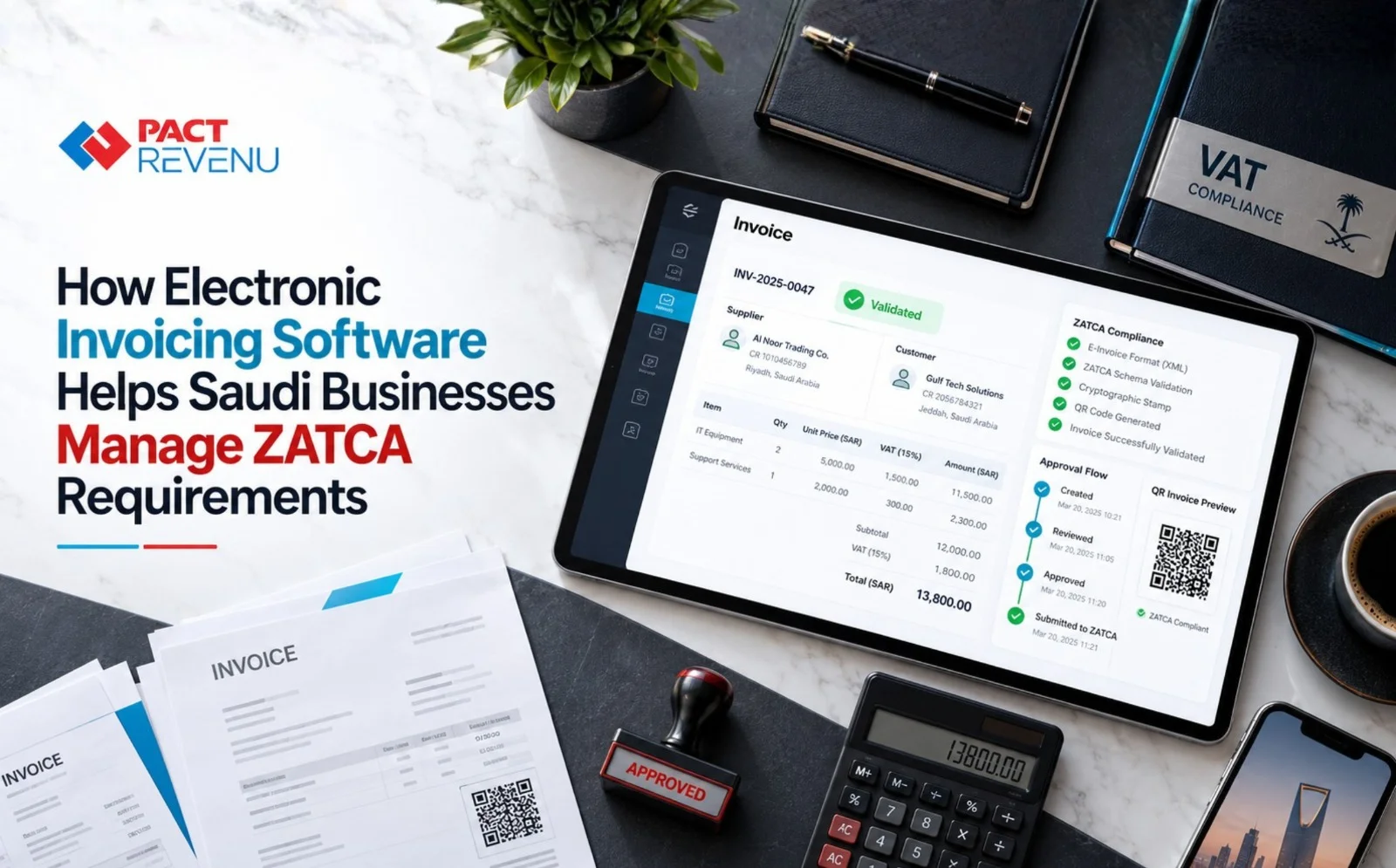
How Electronic Invoicing Software Helps Saudi Businesses Manage ZATCA Requirements
Electronic invoicing software helps Saudi businesses create structured invoices, maintain VAT records, and manage electronic invoicing workflows according to their applicable Zakat, Tax and Customs Authority (ZATCA) requirements. The right solution can also support invoice validation, accounting integration, and reporting, helping finance teams manage documentation more efficiently without relying entirely on manual processes.
Key Takeaways
- Electronic invoicing requirements depend on the business’s applicable ZATCA obligations and implementation phase.
- An electronic invoicing system can help organize invoice generation, validation, storage, and accounting workflows.
- Businesses subject to Phase 2 integration must assess the applicable technical requirements and integration notices.
- Software selection should consider VAT documentation, data security, integration capabilities, and future business needs.
- PACT REVENU can be considered when exploring business software solutions for electronic invoicing workflows in Saudi Arabia.
What Are ZATCA’s Electronic Invoicing Requirements in Saudi Arabia?
ZATCA introduced electronic invoicing, commonly known as Fatoorah, to improve invoice processing, transaction documentation, and tax-related visibility. Businesses covered by the requirements must follow the rules applicable to their transactions and implementation phase.
Saudi Arabia’s electronic invoicing framework includes two main phases:
Phase 1: Generation Phase
Phase 1 requires covered taxpayers to generate and store electronic invoices in accordance with the applicable requirements. Businesses need suitable invoice information, compliant formats, and systems capable of maintaining the required records.
Phase 2: Integration Phase
Phase 2 introduces additional technical requirements for taxpayers notified by ZATCA to integrate their electronic invoicing solutions with the authority’s platform. The requirements include applicable invoice formats, technical specifications, and integration procedures.
Implementation is being introduced in waves. Businesses should check their individual notification, applicable deadline, and current ZATCA guidance rather than assume that every business follows the same timeline.
An electronic invoicing solution should therefore be evaluated against the business’s actual obligations, not simply its ability to create a digital invoice.
How Can Electronic Invoicing Software Help Manage ZATCA Requirements?
Electronic invoicing software can help businesses organize important invoicing activities and reduce avoidable manual work. However, the software must be configured appropriately, and the business remains responsible for meeting its applicable tax obligations.
1. Generate Accurate Electronic Invoices
A suitable system helps finance teams prepare invoices using consistent templates and required transaction information. Depending on the transaction type and applicable rules, this may include seller and buyer details, invoice dates, tax information, totals, and other mandatory fields.
Automated calculations can help reduce errors involving VAT amounts and invoice totals. Businesses should still review tax settings, invoice data, and exceptional transactions to identify incorrect information before issuing invoices.
2. Support Invoice Validation and Integration
For businesses subject to Phase 2, the invoicing solution must support the applicable ZATCA integration and technical requirements.
Depending on the implementation, relevant capabilities may include structured invoice generation, required data fields, applicable XML specifications, cryptographic controls, and communication with the ZATCA platform.
Not every business requires the same integration configuration. Before implementation, confirm the applicable requirements and whether the proposed solution has been assessed against the relevant technical specifications.
3. Maintain Organized VAT Records
An electronic invoicing system can help keep invoice information organized and make records easier to retrieve when reviewing transactions or preparing for tax-related activities.
Useful capabilities may include searchable invoice histories, customer records, tax summaries, and controlled access to stored documents. Businesses should also confirm that record retention, security, backup, and retrieval arrangements meet their legal and operational needs.
4. Connect Invoicing With Accounting Workflows
When invoicing software integrates with accounting or ERP systems, approved invoice information can flow into relevant financial workflows with less repetitive data entry.
This can help teams reconcile transactions, review receivables, track outstanding payments, and prepare accounting records. Integration quality matters: businesses should test tax mappings, duplicate prevention, error handling, and reconciliation procedures before going live.
What Should Saudi Businesses Look for in E Invoice Software?
Choosing e invoice software involves more than comparing prices or invoice templates. The solution should fit the company’s transaction volume, accounting processes, technical environment, and applicable ZATCA requirements.
| Evaluation area | What to check |
| ZATCA requirements | Support for the business’s applicable phase and technical obligations |
| Invoice accuracy | Correct tax calculations, required fields, and validation controls |
| اندماج | Compatibility with accounting, ERP, and required ZATCA workflows |
| Record management | Search, retrieval, access controls, backup, and retention |
| Reporting | Useful invoice, tax, and transaction summaries |
| Scalability | Ability to support changing transaction volumes and business processes |
Before choosing a provider, ask for a demonstration using representative business transactions. Confirm how the solution handles rejected invoices, corrected information, system interruptions, and updates to applicable technical requirements.
An invoice billing software package that works for a small operation may not meet the integration, access control, or reporting needs of a larger organization. Match the solution to your actual requirements.
How Can Businesses Implement an Electronic Invoicing System Effectively?
A planned implementation helps reduce disruption and gives finance teams time to test the system before full deployment.
- Review applicable obligations: Confirm the business’s ZATCA status, transaction types, applicable implementation phase, and any integration notice or deadline.
- Assess current workflows: Review how invoices are created, approved, recorded, corrected, and stored.
- Select suitable software: Evaluate functionality, integration options, security, support, and total implementation costs.
- Configure and test: Check VAT settings, required invoice fields, accounting mappings, and applicable technical requirements. Where Phase 2 applies, test the required integration process.
- Train employees: Ensure finance and accounting teams understand invoice handling, exception management, and record retrieval.
- Monitor after launch: Review errors, rejected transactions, reconciliation differences, and changes to official requirements.
Businesses should also establish a clear process for handling software updates and technical issues. A vendor’s product description alone is not sufficient evidence that a particular configuration meets every applicable obligation.
How Does PACT REVENU Support Saudi Businesses?
PACT REVENU provides business software solutions for organizations exploring ways to improve financial and operational workflows. Businesses in Saudi Arabia can consider its solutions when evaluating how electronic invoicing fits into their broader accounting and business management processes.
When assessing PACT REVENU for your organization, confirm the available electronic invoicing capabilities, accounting or ERP integration options, support arrangements, and suitability for your specific ZATCA obligations. Any product features, integration capabilities, or compliance-related claims should be verified directly before making a purchasing decision.
The right solution should support your day-to-day invoicing needs while fitting your business processes and applicable technical requirements. Successful implementation also depends on accurate business data, suitable configuration, staff training, and ongoing review.
Final Thoughts
Electronic invoicing software can help Saudi businesses improve invoice preparation, organize VAT documentation, and connect invoicing with accounting workflows. However, the appropriate solution depends on the company’s transactions, applicable ZATCA phase, and integration obligations.
Review the latest official guidance, verify your business requirements, and test the proposed system before implementation. A careful selection process can help your team establish a more consistent and manageable invoicing workflow.
Explore Electronic Invoicing Solutions With PACT REVENU
Get in touch with PACT REVENU to explore electronic invoicing solutions for your business. Discuss your current invoicing process, accounting requirements, and applicable ZATCA obligations to determine which solution may suit your organization’s needs.
Frequently Asked Questions
1. Is electronic invoicing mandatory for all businesses in Saudi Arabia?
ZATCA’s electronic invoicing requirements apply to covered taxpayers according to the relevant rules and implementation arrangements. Businesses should confirm their specific obligations, transaction types, and any applicable integration notification.
2. What is the difference between Phase 1 and Phase 2 of ZATCA e-invoicing?
Phase 1 focuses on generating and storing electronic invoices according to the applicable requirements. Phase 2 adds integration and technical requirements for taxpayers included in ZATCA’s implementation waves.
3. Can electronic invoicing software automatically ensure ZATCA compliance?
Software can support required invoice formats, validation, and integration workflows, but it cannot guarantee compliance in every situation. Businesses must verify the solution’s capabilities, configuration, and suitability for their specific obligations.
4. What should businesses check before choosing e invoice software?
Businesses should review applicable ZATCA requirements, invoice validation, accounting integration, record retention, security, reporting, and vendor support. A practical demonstration using real business scenarios can help identify gaps before purchase.
5. Can electronic invoicing software integrate with accounting or ERP systems?
Many solutions offer accounting or ERP integration, but available capabilities vary by product and configuration. Confirm compatibility, tax mappings, error handling, and any required ZATCA integration before implementation.
 AR
AR  EN
EN