
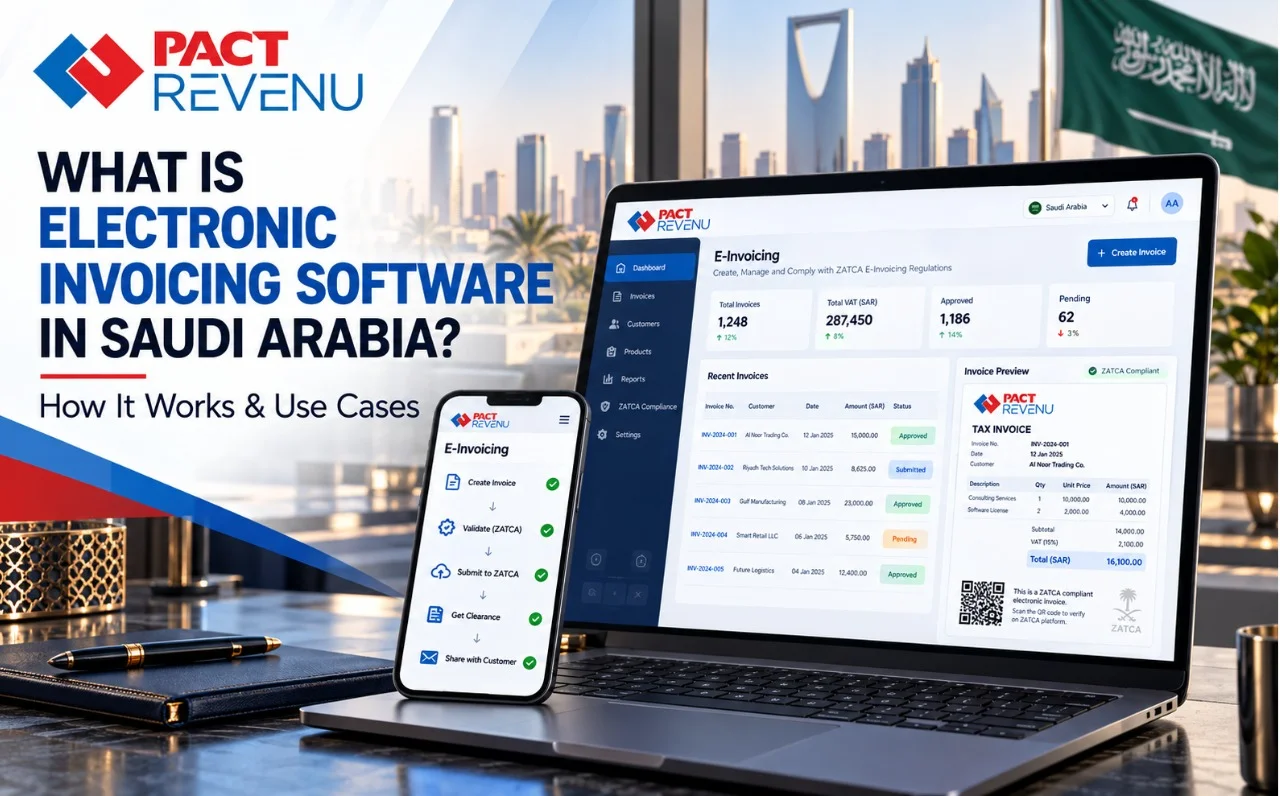
What Is Electronic Invoicing Software in Saudi Arabia? How It Works & Use Cases
Managing invoices through spreadsheets, manual entries, or disconnected systems can create unnecessary work for finance teams. As transaction volumes increase, businesses may also face duplicate data entry, calculation errors, delayed invoice processing, and difficulties maintaining consistent tax records.
For businesses operating in Saudi Arabia, invoicing also needs to be considered alongside the requirements of the Zakat, Tax and Customs Authority (ZATCA).
Electronic invoicing software is a digital system that helps businesses create, manage, store, and process electronic invoices and related credit or debit notes in a structured electronic format. In Saudi Arabia, the software must support the applicable requirements of the ZATCA e-invoicing framework.
ZATCA describes e-invoicing as a process that converts paper-based invoice and note issuance into an electronic process that enables invoices, credit notes, and debit notes to be exchanged and processed in a structured format.
For finance teams, the objective is not simply to replace paper. A properly selected electronic invoicing system can connect invoicing with accounting processes, improve visibility, reduce repetitive work, and support the business’s applicable regulatory obligations.
What Is Electronic Invoicing Software?
Electronic invoicing software is a technology solution used to generate and manage invoices electronically rather than creating them manually or through basic document and spreadsheet tools.
There is an important distinction between a genuine electronic invoice and a scanned or converted document. ZATCA states that an invoice created by scanning or copying a paper invoice into an electronic format is not considered an electronic invoice. An electronic invoice is generated in a structured electronic format through electronic means.
For Saudi businesses, an e invoicing system may support activities such as:
- Creating tax and simplified tax invoices
- Capturing required customer and transaction information
- Applying relevant VAT calculations
- Managing credit and debit notes
- Maintaining invoice records
- Connecting invoicing with accounting or ERP systems
- Supporting applicable ZATCA processes
The exact requirements depend on the type of transaction, taxpayer status, invoice type, and applicable ZATCA rules.
How Does an E Invoice System Work in Saudi Arabia?
The basic workflow can be understood in several steps.
1. Create the invoice
The business creates an invoice using its electronic invoicing software. Customer, product or service, pricing, VAT, and other relevant information are captured within the system.
2. Validate invoice information
The system can check invoice data before issuance. This can help identify missing or inconsistent information and reduce avoidable data-entry errors.
3. Generate the electronic invoice
The invoice is generated electronically according to the applicable requirements. Saudi Arabia distinguishes between tax invoices, generally associated with B2B transactions, and simplified tax invoices, generally associated with B2C transactions.
4. Apply required technical controls
Depending on the applicable ZATCA phase and invoice type, the solution needs to support relevant technical and security requirements. These may include required invoice fields, QR-code functionality for applicable simplified tax invoices, and other technical controls.
5. Connect with ZATCA where required
Saudi e-invoicing was introduced in two phases. Phase 1, the Generation Phase, became effective on December 4, 2021. Phase 2, the Integration Phase, started from January 1, 2023 and is being implemented in waves, requiring targeted taxpayers to integrate their electronic invoicing solutions with ZATCA systems.
6. Deliver the invoice
The invoice can then be provided to the customer according to the applicable requirements and transaction type.
7. Store records
Electronic records should be maintained appropriately so finance teams can retrieve invoices, notes, and supporting information when needed.
Because ZATCA requirements can be updated and Phase 2 is implemented in waves, businesses should verify their current obligations directly with ZATCA rather than relying only on older implementation information.
Why Saudi Businesses Are Moving to Electronic Invoicing Systems
The value of an electronic invoicing system goes beyond creating invoices digitally.
Better invoice accuracy
Automated calculations and structured data entry can reduce common mistakes involving prices, VAT, totals, and customer information.
Faster invoice processing
Finance teams can create and manage invoices without repeatedly preparing documents manually. This can be particularly useful for businesses handling a large number of transactions.
Less repetitive work
When invoicing connects with accounting or ERP systems, businesses may reduce duplicate data entry between different applications.
Better record keeping
Digital invoice records can make it easier for authorized employees to search for historical transactions and supporting documentation.
Improved financial visibility
When invoicing information flows into financial systems, management and finance teams can gain a clearer view of receivables, transaction activity, and outstanding customer payments.
Support for regulatory processes
A suitable electronic invoicing system can help businesses organize their invoicing workflows around applicable ZATCA requirements. However, software should not be treated as an automatic guarantee of compliance; businesses remain responsible for meeting the requirements applicable to them.
Key Features to Look for in Electronic Invoicing Software
When evaluating e invoicing solutions in Saudi Arabia, businesses should look beyond invoice generation.
Important capabilities to evaluate include:
- ZATCA-aligned functionality: The solution should support the requirements applicable to the business’s implementation phase.
- Invoice management: Users should be able to create, manage, search, and track invoices efficiently.
- Automated calculations: Useful for reducing manual calculation work and inconsistencies.
- VAT functionality: The system should support relevant VAT-related invoice information.
- Credit and debit notes: Important when invoices need legitimate adjustments.
- Customer and supplier management: Centralized information can reduce repeated data entry.
- Accounting or ERP integration: Integration can help connect invoicing with broader financial workflows.
- Audit trails: Businesses should evaluate how invoice activities and changes are recorded.
- Secure record management: Invoice data should be stored and managed using appropriate controls.
- Reporting: Finance teams should have access to useful invoice and transaction reports.
- User permissions: Different employees may require different levels of system access.
- Scalability: The solution should remain practical as transaction volumes and business operations grow.
- Implementation support: Clear onboarding and technical assistance can make adoption easier.
ZATCA maintains an indicative directory of solution providers, but it also states that taxpayers can use other solutions provided that the solution complies with applicable e-invoicing requirements.
Common Use Cases for E Invoicing Software in Saudi Arabia
1. B2B invoicing
Companies selling products or services to other businesses can use electronic invoicing software to manage recurring and one-time tax invoices while keeping transaction information organized.
2. B2C transactions
Retailers, service providers, and other businesses serving consumers can use electronic systems to streamline customer billing and applicable simplified tax invoice processes.
3. High-volume invoicing
Businesses that generate hundreds or thousands of invoices may benefit from automation because repetitive invoice preparation can consume significant finance-team time.
4. Multi-branch businesses
Companies operating across multiple branches can use centralized invoice management to maintain more consistent processes and improve visibility across locations.
5. ERP and accounting integration
Connecting invoicing with an accounting or ERP platform can reduce duplicate data entry and help invoice information flow into broader financial processes.
6. Credit and debit notes
When an invoice needs an adjustment, businesses can manage relevant credit or debit notes through a structured process rather than relying on disconnected documents.
7. Growing Saudi businesses
As a business expands, its invoicing requirements may become more complex. A scalable electronic invoicing system can provide a more organized foundation for growing transaction volumes and finance operations.
Electronic Invoicing Software vs Manual Invoicing
| Area | Manual Invoicing | Electronic Invoicing Software |
| Invoice creation | Often requires manual preparation | Digital invoice creation |
| Data entry | More repetitive | Can be automated or integrated |
| Error management | Depends heavily on manual checks | Validation and automated calculations may help |
| Record keeping | Can involve separate files | Centralized digital records |
| Automation | Limited | Higher potential for workflow automation |
| Reporting | Often requires manual consolidation | Built-in reporting may be available |
| Scalability | Can become difficult at higher volumes | Designed to support larger transaction volumes |
| Compliance support | Requires significant manual control | Can provide functionality aligned with applicable requirements |
The right approach depends on the company’s size, transaction volume, existing systems, processes, and regulatory obligations.
How to Choose the Right E Invoicing Solution in Saudi Arabia
Before selecting an electronic invoicing platform, finance leaders should evaluate the solution against their actual business workflow.
Ask:
- Does the software support the ZATCA requirements applicable to our business?
- Can it integrate with our existing accounting or ERP system?
- Can it handle our current invoice volume?
- Will it support future business growth?
- Does it provide useful reports and audit trails?
- Is implementation practical for our finance team?
- What customer and technical support does the provider offer?
- Can employees use the system without unnecessary complexity?
- What security and data-management controls are available?
Businesses should also check how frequently the provider updates its software when regulatory or technical requirements change.
How PACT Revenue Can Help
For Saudi businesses looking to modernize invoicing and financial workflows, PACT Revenue can be considered as a technology partner during the evaluation process.
Rather than selecting software based only on a feature list, businesses should first understand their invoicing volume, transaction types, accounting workflow, integration needs, and applicable ZATCA requirements.
Looking to simplify electronic invoicing for your Saudi business? Talk to PACT Revenue to explore an approach suited to your invoicing and finance workflow.
Frequently Asked Questions
1. What is electronic invoicing software?
Electronic invoicing software is a digital system used to create, manage, process, and store invoices electronically in a structured format. In Saudi Arabia, the solution should support the applicable ZATCA e-invoicing requirements.
2. Is electronic invoicing mandatory in Saudi Arabia?
ZATCA’s e-invoicing requirements apply to taxpayers covered by the relevant regulations, with implementation introduced through Generation and Integration phases. Phase 2 is being implemented in waves. Businesses should verify their current applicability and wave requirements directly with ZATCA.
3. How does an e invoice system work with ZATCA requirements?
The system generates electronic invoices according to applicable requirements. During Phase 2, targeted taxpayers must integrate their electronic invoicing solution with ZATCA’s systems and generate invoices in the required format.
4. What businesses can use e invoicing software?
Businesses subject to applicable Saudi e-invoicing requirements can use compliant electronic invoicing solutions. The practical setup depends on the business’s tax status, transaction types, invoice volumes, systems, and applicable ZATCA requirements.
5. How do I choose electronic invoicing software in Saudi Arabia?
Compare solutions based on applicable ZATCA requirements, invoice volume, accounting or ERP integration, reporting, audit trails, security controls, scalability, usability, implementation, and ongoing support.
 EN
EN  AR
AR